News detail
The Engineering Logic of Mobility: High-Capacity Trailer Mounted Amusement Rides
The core value of Trailer Mounted Amusement Rides lies in the total elimination of traditional assembly logistics. Unlike static units that require cranes and multi-day setup windows, these systems are engineered as a cohesive, road-legal vehicle. By integrating a heavy-duty industrial chassis with advanced Automatic Folding Amusement Rides technology, a high-capacity attraction can transition from a highway trailer to a fully operational amusement site in under 60 minutes.
For professional carnival operators and event organizers, Trailer Mounted Amusement Rides represent the peak of asset liquidity. The ability to tow an attraction to any geographic coordinate and deploy it via hydraulic automation is the ultimate hedge against rising labor costs and the physical limitations of temporary venues.
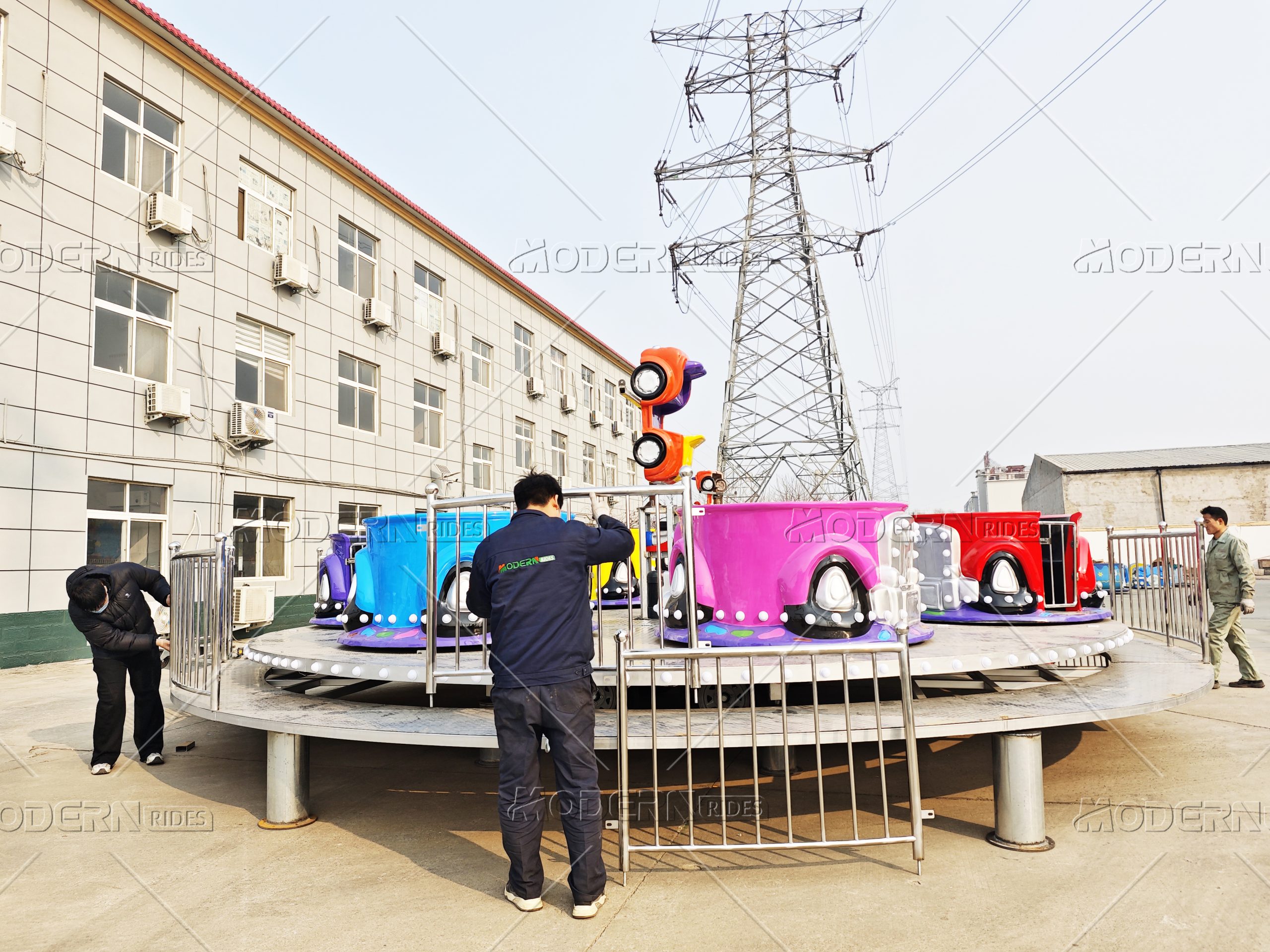
1. Kinematics of Automatic Folding Amusement Rides
The mechanical "magic" of Automatic Folding Amusement Rides is found in the multi-stage hydraulic synchronization. The entire structure is designed to fold into a compact, aerodynamic profile that meets international highway width and height regulations without requiring oversized load permits.
-
Integrated Hydraulic Actuation: Using a centralized high-pressure pump system, the Automatic Folding Amusement Rides deploy their main support masts and radial arms in a pre-programmed sequence. This eliminates the risk of human error during manual assembly and ensures that all structural locking pins are engaged with 100% repeatability.
-
Chassis-to-Ground Stabilization: Once the unit is positioned, hydraulic outriggers extend directly from the truck frame. These outriggers bypass the vehicle's suspension, creating a rigid, direct-to-earth connection. This provides the stability of a permanent foundation without the need for a single ground bolt or concrete pad.
2. Structural Integrity of Self-Deploying Mobile Rides
A primary engineering concern with Self-Deploying Mobile Rides is whether the folding joints compromise the overall rigidity of the machine during high-speed operation. At MODERN, we utilize "Interlocking Structural Knuckles" at every critical pivot point.
-
Load-Bearing Pivot Pins: We utilize 40Cr steel pins, induction-hardened to handle the high-cycle fatigue of daily deployment and retraction. When the Self-Deploying Mobile Rides reach their full extension, the joints are not just held by hydraulic pressure; they are mechanically locked with secondary safety pins to ensure structural redundancy.
-
Torsional Rigidity: The integrated trailer chassis is manufactured from high-tensile Q355B steel, reinforced with internal webbing to resist the twisting forces (torque) generated by the rotational mass of a fully loaded attraction.
3. Spatial ROI: The Efficiency of Towable Theme Park Rides
In a commercial environment, the Trailer Mounted Amusement Rides configuration offers a unique Return on Investment (ROI) profile based on "Zero-Labor" deployment and high throughput.
-
Rapid Market Entry: A standard high-capacity attraction usually requires a 4-person crew and a full day of heavy lifting. A Towable Theme Park Rides unit requires only 1 operator and approximately 30 minutes of setup. In a typical weekend event, this saves over 40 man-hours in labor costs alone.
-
Asset Velocity: Because the ride serves as its own transport vehicle, you eliminate the overhead of secondary flatbed rentals and crane services. The high-capacity seating ensures maximum ticket revenue per cycle, while the mobility allows you to move between fairgrounds, city festivals, and corporate events with zero downtime.
[Image Placeholder: Comparison chart showing Setup Time vs. Labor Costs for stationary vs. trailer-mounted mobile models]
Hardcore Engineering FAQ: Trailer Mounted Amusement Rides (Over 500 Words)
Q1: How do Trailer Mounted Amusement Rides ensure safety during high-speed highway transit?
A: This is the most critical phase of the ride's lifecycle outside of operation. Every Trailer Mounted Amusement Rides unit is engineered with a low center of gravity (CG) to prevent sway during towing. The internal components—including the seating units and decorative fascias—are secured into integrated "Transport Cradles." These cradles utilize vibration-damping mounts to protect the finish and structural joints from the harmonic shocks of the road. Furthermore, the braking system is synchronized with the towing vehicle via a dual-line pneumatic or electronic brake controller, ensuring the Towable Theme Park Rides can come to a full stop in an emergency without jackknifing.
Q2: Can the Automatic Folding Amusement Rides be deployed on soft or unpaved ground?
A: Yes. Unlike stationary rides that require a leveled concrete pad, Automatic Folding Amusement Rides utilize independent, large-footprint hydraulic leveling jacks. These jacks are designed to distribute the "Point Load" over a wider surface area. We provide secondary high-density polyethylene (HDPE) spreader plates for use on grass or gravel. The system's integrated digital inclinometers confirm that the main chassis is within the strict $0.5^\circ$ tolerance for vertical plumb before the deployment sequence is allowed to initiate, ensuring safe operation on imperfect terrain.
Q3: What fail-safes are in place for the hydraulics of Self-Deploying Mobile Rides?
A: Safety is non-negotiable for Self-Deploying Mobile Rides. Every hydraulic cylinder is equipped with "Counterbalance Valves" (also known as load-holding valves). These act as a physical hydraulic lock; if a hose bursts or the pump loses power, the fluid is trapped inside the cylinder, locking the arm or mast in its current position. It is physically impossible for the ride to "collapse" or drop unexpectedly. Additionally, we provide a manual override system, allowing the operator to safely retract the Self-Deploying Mobile Rides back into their trailer configuration even during a total electrical failure.
Q4: How does the "Chassis-Integrated" design affect long-term maintenance compared to stationary rides?
A: The "Chassis-Integrated" nature of Mobile Hydraulic Amusement Rides actually simplifies maintenance. Because the entire mechanical assembly is at ground level when folded, all critical grease points, hydraulic manifolds, and electrical junctions are accessible without the need for scaffolding or man-lifts. We utilize centralized lubrication blocks, allowing a technician to grease all pivot "knuckles" from a single location. For high-frequency operators, we mandate a visual inspection of the hydraulic seals every 30 days and a comprehensive ultrasonic "Pin-Stress Test" annually to ensure the integrity of the folding joints.
Q5: How do you prevent wind-load issues for these Mobile Hydraulic Amusement Rides when deployed?
A: When fully expanded, these rides act as a significant "sail" area. To mitigate wind risk, the hydraulic outriggers create a "Wide-Stance" footprint that is significantly larger than the rotational radius of the ride. This geometry provides a massive stabilizing moment. For outdoor operations, our Mobile Hydraulic Amusement Rides are rated for operation in winds up to 15 m/s. If the forecast exceeds this, the ride can be partially retracted or fully folded back into its compact trailer state in minutes, significantly reducing its wind profile and protecting the asset from storm damage.
Conclusion
Trailer Mounted Amusement Rides represent the peak of modern entertainment logistics—transforming a massive structural asset into a nimble, self-deploying revenue generator. By combining a heavy-duty chassis with intelligent hydraulic folding, we provide park owners with a high-ROI, high-mobility solution that meets the most stringent international safety and transport standards.
Would you like a detailed "Towing & Weight Specification" sheet to see if your current fleet vehicles are compatible with our mobile hydraulic models?
Online Message
Please leave the message you want to inquiry. We will reply you as soon as possible within 24 hours.