News detail
Pro Buyer’s Guide to Drop Tower Procurement: Drive Systems, Cost Analysis, and Safety Benchmarks
1. Drive System Selection: What are the fundamental differences between Pneumatic and Cable Hoist systems?
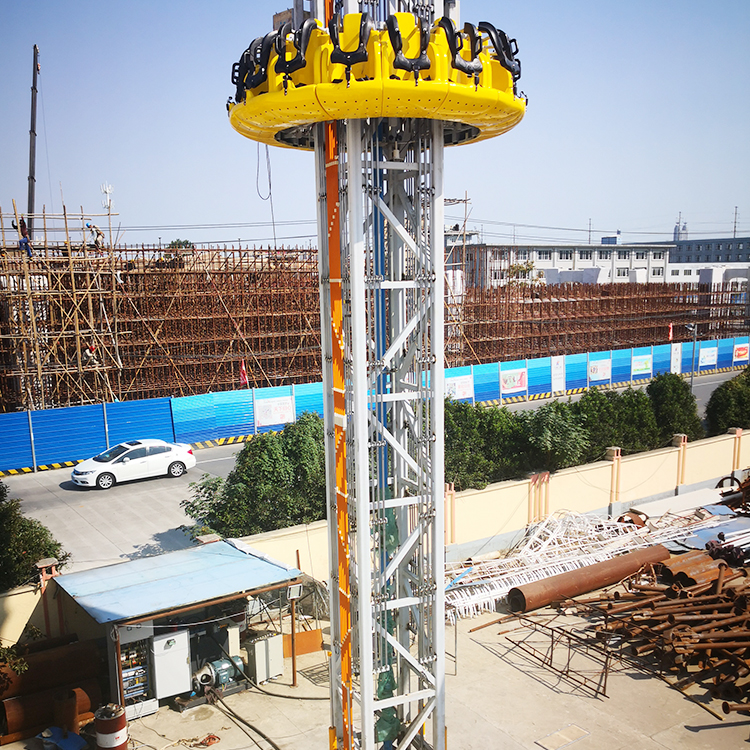
When choosing a propulsion system, the decision dictates both the "thrill factor" and long-term maintenance overhead. Pneumatic Systems leverage high-pressure air for an explosive launch, offering a signature "hissing" sound that acts as a powerful marketing tool for outdoor parks. However, they demand high-precision air-tightness monitoring and valve maintenance.
In contrast, Steel Cable Hoist Systems represent the industry's most reliable and time-tested solution. They operate with significantly lower noise and offer a linear, smooth ascent. Because motors, gearboxes, and cables are globally standardized components, this is the preferred choice for indoor malls and luxury resorts where noise control and ease of local parts sourcing are critical.
2. Safety Core: Why is Magnetic Braking a non-negotiable standard for modern Drop Towers?
In drop tower engineering, "how you stop" is far more critical than "how you rise." MODERN has phased out traditional friction brakes, which are prone to wear and affected by weather conditions, in favor of Permanent Magnet Braking Systems (Eddy Current Braking).
This system utilizes the physical principle of eddy currents to generate a braking force without any electrical power. This means that even in the event of a total park power failure, the gondola will automatically and smoothly decelerate through the magnetic fins. This "fail-safe" physical design eliminates the risks associated with mechanical or electrical failure.
3. 2026 Procurement Budget: Market Price Benchmarks for Various Heights
Based on global supply chain data for 2026, the procurement cost (FOB guide price) for drop towers is as follows:
-
15-22 Meters (Family/Entry-level): Approx. $150,000 - $320,000. These models have lower foundation requirements and offer a rapid ROI for medium-sized parks.
-
30-45 Meters (Mainstream Attraction): Approx. $450,000 - $780,000. This is the "sweet spot" for ROI, balancing visual impact with reasonable civil engineering costs.
-
50-80 Meters (Giant Landmark): Approx. $1,100,000 - $2,500,000+ (highly dependent on custom theming and launch technology).
-
Note: Prices exclude civil foundations, customs clearance, and local taxes.
4. Technical Comparison: Pneumatic vs. Cable Hoist
Use the following table to quickly identify the best fit for your specific venue:
| Key Dimension | Pneumatic Drive | Cable Hoist Drive |
| Experience Feedback | Explosive launch, high-impact start | Smooth linear ascent, pure free-fall |
| Noise Control | Significant (Powerful air exhaust) | Minimal (Ultra-quiet operation) |
| Maintenance Focus | Air seals and valve precision | Cable inspection and motor lubrication |
| Preferred Setting | Outdoor theme parks, adventure hubs | Indoor malls, high-end resorts |
5. Compliance: How do you facilitate local safety inspections and certifications?
Regulatory compliance is the cornerstone of any project. MODERN’s independent design institute provides comprehensive engineering calculations, material test reports, and 3D stress analysis based on ASTM (USA) or EN (EU) standards. We deliver a full technical documentation package designed to clear third-party audits (e.g., TÜV, SGS) and local government safety inspections seamlessly.
6. Environmental Engineering: Anti-corrosion solutions for high-salinity and hurricane zones
For coastal or high-humidity regions, the corrosion resistance grade determines the asset's lifespan. We utilize Hot-Dip Galvanization for the entire steel structure, finished with three layers of automotive-grade fluorocarbon paint. Additionally, units are equipped with lightning protection and ultrasonic wind sensors; once winds exceed Level 6 safety thresholds, the control system automatically locks the ride to ensure structural integrity.
7. Passenger Safety: How do Dual Hydraulic Locking Systems prevent operator error?
We employ dual-circuit hydraulic locking safety restraints integrated with "seat-occupied" sensors. Our logic-locked control system ensures that the launch sequence cannot be initiated unless every lap bar is physically locked and pressure-verified. This design eliminates the possibility of accidents caused by human oversight. Furthermore, emergency release valves allow operators to safely lower the gondola manually during power outages.
8. Maintenance Efficiency: Can core spare parts be sourced locally?
To minimize downtime, MODERN uses global brands like Siemens and Schneider for PLCs, inverters, and low-voltage electrical components. This means you don't have to wait for expensive international shipping for minor electronic parts; you can source them from your local industrial automation market, drastically reducing repair costs and downtime.
9. ROI Analysis: Estimating attraction value and payback periods
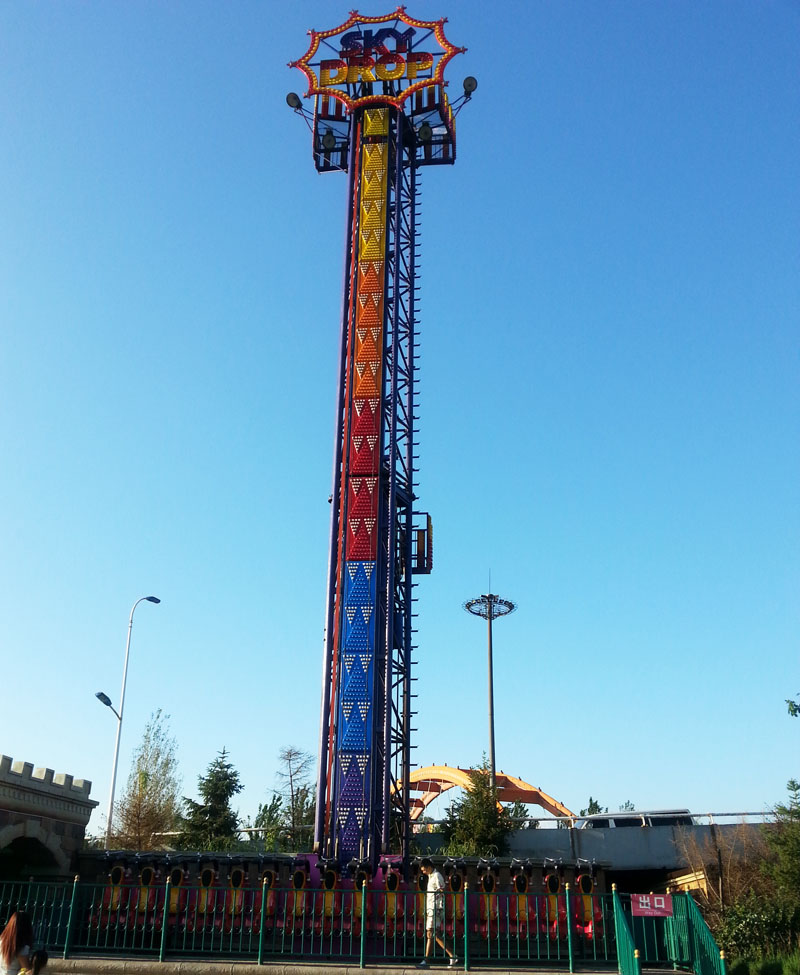
Drop towers offer an exceptionally high "throughput-to-footprint" ratio. A 30-meter model attracts high foot traffic due to its vertical presence. Based on our client data, the combination of direct ticket sales and the "landmark effect" that drives secondary spending typically allows park owners to recover their equipment investment within 12-18 months.
10. Customization: Enhancing social media virality through IP Theming
We provide deep customization services. Leveraging our professional Fiberglass (FRP) molding capabilities, we can theme your tower into sci-fi stations, rainforest totems, or steampunk towers. High-impact visual theming significantly increases the likelihood of visitors sharing their experience on social media, generating long-term organic traffic for your venue.
11. Energy Consumption: What is the daily power cost for a large tower?
By utilizing Variable Frequency Drives (VFD) and gravitational energy recovery, power consumption is largely concentrated in the ascent phase. A 40-meter model consumes roughly 5-8 kWh per cycle. For an 8-hour operating day, electricity costs are a negligible fraction of total OPEX. We also provide energy-saving modes for off-peak hours to further optimize costs.
12. Site Requirements: Foundation depth and load-bearing standards
A drop tower foundation typically requires a bearing capacity of 250-350 kN/m². Foundation depth, usually between 2 to 4 meters, depends on local soil conditions. We provide detailed geological load requirements and guide your local civil engineering team through the reinforced concrete pouring process to ensure absolute stability under high-frequency impact.
13. Logistics: Reducing international shipping costs for over-sized tower sections
High-altitude tower sections are "Out-of-Gauge" (OOG) cargo. MODERN uses a modular flange-connection design, allowing the tower to be broken down into segments that fit into standard 40FR or 40HQ containers. By optimizing packing volume, we typically save buyers 15%-20% in transoceanic freight costs compared to traditional designs.
14. Climate Adaptation: Protecting electronics in extreme heat or cold
For extreme climates (-20°C to 50°C), we equip control cabinets with independent industrial-grade air conditioning. Critical mechanical lubricants are also swapped for extreme-temperature grades, ensuring that sensors and hydraulic pumps operate flawlessly in both Middle Eastern deserts and Nordic winters.
15. Upgradability: Can older units be retrofitted with VR or interactive lighting?
Absolutely. Our control systems come with pre-configured synchronization interfaces. This allows for easy integration of VR headsets, tower-wide LED matrix synchronization, or immersive sound systems. Such low-cost retrofits keep your attraction fresh and competitive even 3-5 years after the initial launch.
Conclusion: Engineering precision is the only guarantee for long-term profitability
Procuring a drop tower is a long-term capital investment. Choosing MODERN means securing international engineering standards and life-cycle technical support. We use rigorous manufacturing benchmarks to safeguard every cent of your investment.
Online Message
Please leave the message you want to inquiry. We will reply you as soon as possible within 24 hours.