News detail
Pirate Ship Ride Size: Area Needed for Each Model
Introduction
If you’ve ever tried to place a pirate ship ride into a real park layout, you’ll quickly realize one thing:
Pirate Ship Ride Size is never just about the equipment itself.
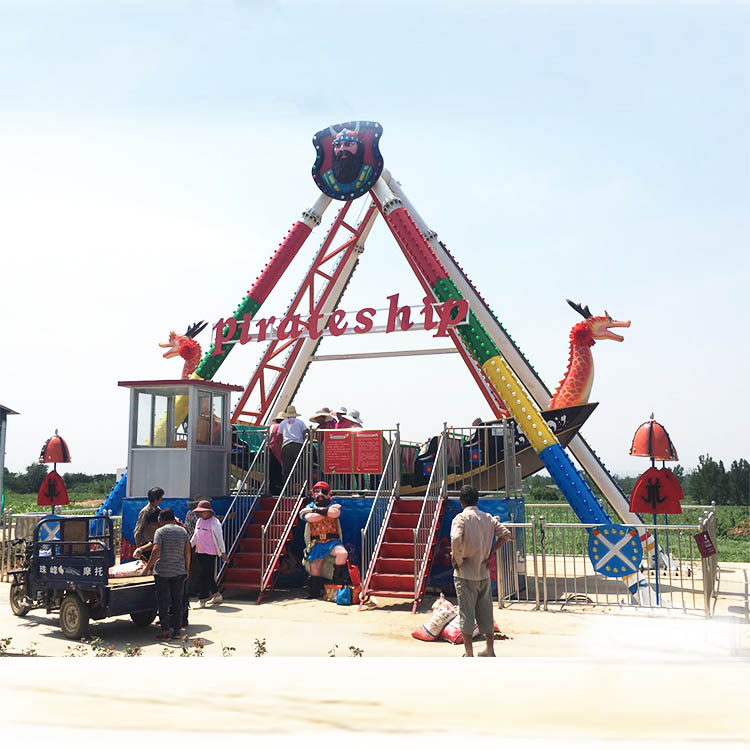
On paper, a pirate ship may look like a simple rectangular footprint. But once installed, the swinging motion, safety clearance, boarding area, and crowd flow all expand the actual space requirement—sometimes far beyond initial expectations.
In many projects we’ve seen at MODERN, the biggest adjustment doesn’t happen during manufacturing—it happens when the equipment arrives on-site and suddenly “the space feels too tight.”
This guide focuses on one practical question:
👉 How much space does each Pirate Ship Ride Size really require in real conditions?
Before We Talk Models: Why Pirate Ship Space Is Often Misjudged
Compared to carousel rides, pirate ships introduce one extra variable:
swing amplitude (forward + backward movement)
This means:
- The ride doesn’t just occupy ground space
- It also requires clearance in the swing direction
- And that clearance must remain completely unobstructed
So when we talk about Pirate Ship Ride Size, we are really talking about a dynamic safety zone, not a static footprint.
12-Seat Pirate Ship Ride Size — Small, But Not “Flexible”
- Equipment length: ~6–7 m
- Equipment width: ~3–4 m
- Recommended area: 8 × 6 m
This is typically the smallest model, often used in:
- Indoor parks
- Small outdoor amusement zones
At first glance, it seems easy to install. But in practice:
- The swing still requires front/back clearance
- Operator standing space is often overlooked
- Indoor ceiling height becomes a limiting factor
Real observation:
Even small pirate ships feel “tight” if the front clearance is compressed—it directly affects perceived safety.
24-Seat Pirate Ship Ride Size — The First “True Attraction” Scale
- Equipment length: ~8–10 m
- Equipment width: ~4–5 m
- Recommended area: 12 × 8 m
This is where pirate ships start to behave like core park equipment, not just a side attraction.
What changes here:
- Swing height becomes more noticeable
- Spectators begin gathering around
- Boarding takes longer due to more riders
If space is not properly allocated:
- Queues spill into walkways
- Operator visibility becomes limited
This is often the minimum size for outdoor parks, but it already requires layout thinking.
40-Seat Pirate Ship Ride Size — Where Space Planning Becomes Critical
- Equipment length: ~10–12 m
- Equipment width: ~5–6 m
- Recommended area: 15 × 10 m
At this level, the pirate ship is no longer just equipment—it becomes a movement center.
Common on-site changes:
- People stop to watch, not just ride
- Waiting areas naturally expand
- The swing arc becomes visually dominant
Here’s where many projects go wrong:
They allocate space based on the ride body,
but ignore the psychological space people create around it.
Result:
- Congestion near entrance
- Safety distance reduced unintentionally
- Poor visitor flow
72-Seat Pirate Ship Ride Size — Not Just Installation, But Layout Strategy
- Equipment length: ~13–16 m
- Equipment width: ~6–7 m
- Recommended area: 18 × 12 m or larger
At this scale, the pirate ship becomes a major attraction anchor.
What you need to consider is no longer just “can it fit”, but:
- How will crowds gather around it?
- Where will queues form during peak hours?
- Can emergency access still be maintained?
In several real projects, clients initially tried to compress space to save land.
Later, they had to rebuild fencing or adjust pathways, which cost far more than planning correctly from the start.
Quick Reference (Based on Real Installations)
| Seats | Equipment Length | Recommended Area |
|---|---|---|
| 12 | 6–7 m | ~8 × 6 m |
| 24 | 8–10 m | ~12 × 8 m |
| 40 | 10–12 m | ~15 × 10 m |
| 72 | 13–16 m | ≥18 × 12 m |
These values are not “tight-fit” numbers—they are safe operational ranges.
What Buyers Usually Underestimate
Across different markets, the same issues repeat:
1. Swing Clearance
Unlike static rides, pirate ships require empty space in motion direction.
Reducing this space is one of the most common planning mistakes.
2. Crowd Behavior
People don’t stand neatly. They:
- Watch
- Take photos
- Wait unpredictably
This expands the real footprint.
3. Entry and Exit Flow
At 40+ seats, uncontrolled boarding leads to:
- Delays
- Confusion
- Safety risks
4. Maintenance Access
Technicians need access to:
- Support structures
- Drive systems
- Safety checks
Tight layouts make daily inspection inefficient.
How Experienced Buyers Choose the Right Pirate Ship Ride Size
From actual project experience, decisions usually come down to three questions:
1. How much space is truly usable?
Not total land—but usable, unobstructed space.
2. Is this a supporting ride or a main attraction?
- Small parks → 12–24 seats
- Medium parks → 24–40 seats
- Destination parks → 40–72 seats
3. Will this area become a crowd center?
If yes, space must include:
- Queue zones
- Viewing space
- Safety buffers
Why Layout Planning Matters More Than Equipment Specs
A pirate ship that “fits” is not the same as one that operates smoothly.
At MODERN, real project support often includes:
- Adjusting layout based on site shape
- Planning swing direction relative to pathways
- Ensuring inspection and maintenance access
Because once installed, changing layout is always more expensive than planning it correctly.
Conclusion
Understanding Pirate Ship Ride Size is not about memorizing dimensions—it’s about anticipating how the ride behaves in real space.
Each model—from 12 seats to 72 seats—brings a different level of:
- Movement
- Crowd interaction
- Operational complexity
Ignoring these differences doesn’t stop installation—but it almost always creates problems later.
Final Thought
When choosing a pirate ship, don’t just ask:
“Can this ride fit in my site?”
Ask instead:
“Will this space still work when the ride is running, crowded, and operating at full capacity?”
Online Message
Please leave the message you want to inquiry. We will reply you as soon as possible within 24 hours.