News detail
Park Civil Engineering: Concrete Foundations, Anchor Bolts & Rigging Safety
Park Civil Engineering: Concrete Foundations, Anchor Bolts & Rigging Safety
Executive Summary for Project Engineers & Civil Contractors:
Primary Operational Goal: Execute structural civil engineering, ground foundation pour, and heavy crane rigging to safely set permanent park-scale rides.
Core Engineering Standards: Concrete pad design mastering dynamic rotational forces and soil bearing capacity, utilizing high-tensile anchor-bolt arrays engineered to ASTM F2291 standards.
Quality Assurance Protocols: Non-destructive testing (NDT), torque-tension verification, and ultrasonic bolt testing prior to final ride superstructure erection.
Safety & Rigging Management: Rigorous critical lift planning, multi-point rigging safety, and structural fatigue risk removal to prevent premature bearing and fatigue failures.
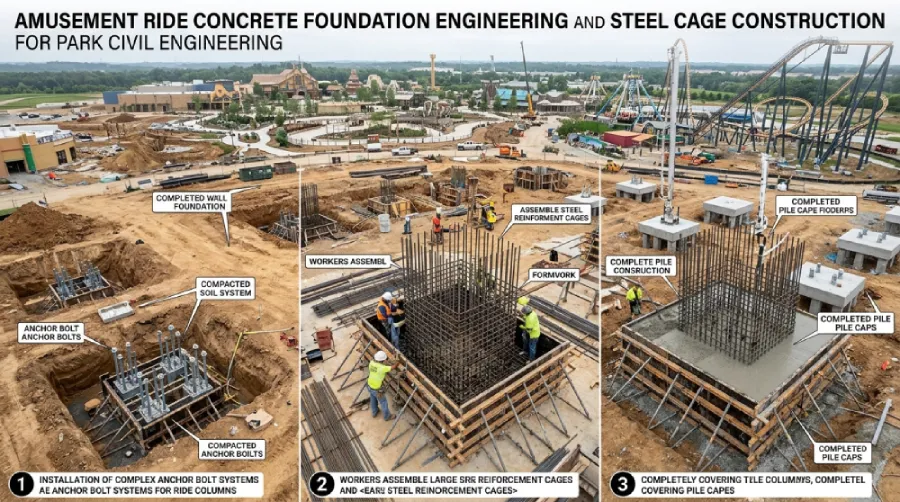
Executing rigorous park civil engineering is the most critical structural phase of any commercial amusement park project. Specifically, when visitors experience thrilling drops and high-speed rotations on park rides, they rely on unseen tons of concrete and steel anchored deep underground. Therefore, even the most advanced roller coaster or giant Ferris wheel will experience premature structural fatigue or shaft misalignment if mounted on an inadequate foundation.
The Foundation of Ride Safety: Why Civil Engineering Comes First in Park Projects
Securing a flawless civil engineering and installation plan bridges the gap between raw machinery delivery and long-term operational safety.
Specifically, static weight calculation is only a fraction of the challenge. Engineers must account for multi-directional dynamic overturning moments, soil settling, wind shear loads, and thermal expansion across decades of continuous operation.
1. Geotechnical Soil Analysis and Concrete Foundation Design in Park Civil Engineering
Amusement park rides generate complex combinations of static dead loads, live passenger loads, and extreme dynamic overturning moments. Therefore, geotechnical engineering must safely transfer these dynamic forces into the earth.
Geotechnical Survey and Soil Bearing Capacity
Before pouring concrete, geotechnical engineers perform core drilling soil tests to determine:
-
Soil Bearing Capacity (qa): Engineers determine whether shallow spread footings are sufficient or if deep friction piles are required.
-
Seismic and Wind Load Resistance: Technicians factor regional wind shear forces (up to 150 km/h in-service/out-of-service limits) into foundation depth and mass calculations.
High-Strength Reinforced Concrete Formwork
-
Compressive Strength: Foundations utilize high-grade structural concrete with a minimum 28-day compressive strength of C30/37 to C40/50 (30–40 MPa / 4,350–5,800 PSI).
-
Dynamic Steel Rebar Cages: Heavy rebar cages (ASTM A615 Grade 60) absorb shear vectors and dynamic moment forces generated by rotating swing rides, pendulum attractions, and coasters.
2. Anchor Bolt Engineering and Tension Verification in Park Civil Engineering
Anchor bolts form the structural joint connecting the ride’s steel base plates directly to the reinforced concrete mass.
High-Tensile Steel Grade Selection
-
Material Standards: Construction teams utilize high-grade Grade 8.8, 10.9, or ASTM A193 B7 high-tensile alloy steel threaded rods.
-
Precision Template Layout: Rigid steel templates hold anchor bolt arrays in place during concrete pouring, ensuring zero misalignment across bolt circle diameters.
Torque Tensioning and Post-Pour Testing
Once the concrete achieves 100% cure strength, engineers perform rigorous quality control checks before column mounting:
-
Calibrated Hydraulic Tensioning: Technicians tension anchor bolts to exact foot-pounds (Nm) of torque using calibrated hydraulic torque wrenches.
-
Ultrasonic NDT Testing: Non-destructive ultrasonic testing verifies that zero micro-fractures occurred during post-tensioning, proving the bolt array is capable of withstanding maximum dynamic overturning forces.
3. Heavy Crane Rigging Safety and Superstructure Erection
Erecting massive steel towers, main bearing housings, and track sections requires precise heavy lift planning and certified rigging crews.
The Critical Lift Plan
For lifts involving primary ride towers or components weighing over 10 tons, engineers execute a formal Critical Lift Plan:
-
Crane Capacity Margin: Operators run mobile cranes at no more than 75% of their rated chart capacity for the given radius and boom length.
-
Rigging Hardware Validation: Multi-leg wire rope slings, shackles, and spreader beams must carry tagged Working Load Limits (WLL) with a minimum 5:1 safety factor.
Aligning Permanent vs. Mobile Equipment Strategy
Permanent park rides require weeks of excavation, concrete curing, and heavy crane rigging. However, park developers often integrate high-flexibility mobile equipment into their master plan.
Specifically, utilizing trailer mounted carousel rides allows developers to introduce immediate revenue-generating attractions without waiting for lengthy civil foundation curing cycles.
Foundation & Civil Engineering Quality Control Matrix
| Engineering Inspection Gate | Testing Method / Standard | Passing Acceptance Criteria |
| Soil Subgrade Stability | Plate Bearing / Core Sample | Meets or Exceeds Design $q_a$ (kPa) |
| Concrete Cure Strength | Cylinder Compression Test (ASTM C39) | 100% Rated PSI Achieved (28 Days) |
| Anchor Bolt Alignment | Optical Laser Station Measurement | Zero Variance Beyond ±1.5 mm Tolerance |
| Bolt Torque Tension | Calibrated Hydraulic Torque Wrench | Matches Manufacturer Tension Spec |
| Structural Weld Rigging | Ultrasonic NDT / Magnetic Particle | 100% Weld Penetration, Zero Cracks |
Partnering with MODERN for End-to-End Installation Engineering
Executing safe ride installation requires close collaboration between ride manufacturers and project engineers. Specifically, MODERN provides complete foundation blueprints, anchor bolt layout templates, and technical field supervision to guarantee your attractions meet exact global safety standards.
Planning civil works for your next amusement park project? Contact our civil engineering technical team to request foundation schematics, anchor bolt templates, and installation support.


Online Message
Please leave the message you want to inquiry. We will reply you as soon as possible within 24 hours.