News detail
Foundationless Carousel Ride Design and Compliance
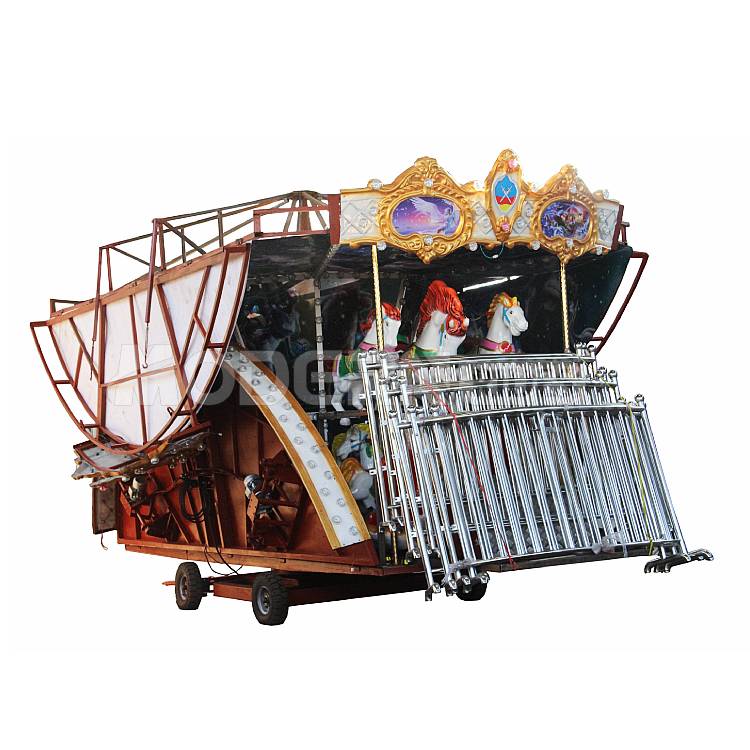
A Foundationless Carousel Ride is engineered to operate safely without permanent concrete anchoring. Unlike traditional fixed carousels that require embedded foundation bolts and reinforced slabs, a Foundationless Carousel Ride relies on an integrated structural steel chassis to distribute static and dynamic loads across a widened footprint.
For commercial developers and amusement park investors, this configuration reduces civil construction cost while preserving structural stability — provided engineering and manufacturing are executed correctly.
Structural Engineering Principles of a Foundationless Carousel Ride
The structural safety of a Foundationless Carousel Ride depends on base-frame load distribution and anti-overturning calculation.
Typical technical parameters for a mid-size commercial unit:
-
Diameter: 8–10 meters
-
Rated capacity: 16–24 riders
-
Rated live load reference: 75 kg per rider
-
Total machine weight: 8–12 tons
-
Rotation speed: 3–6 RPM
-
Ground bearing requirement: typically ≥100 kN/m²
The base frame is usually fabricated from Q235B or Q355 structural steel (or equivalent), with reinforced radial beams extending from the central hub. These beams distribute vertical load evenly while resisting lateral torque generated during rotation.
Overturning resistance calculations consider:
-
Maximum unbalanced rider load
-
Emergency braking torque
-
Wind load (outdoor installation)
-
Dynamic amplification factor
A properly engineered Foundationless Carousel Ride maintains a safety factor typically between 3.0–4.0 for primary load-bearing components.
Manufacturing Process: Factory-Level Implementation
A professionally built Foundationless Carousel Ride is the result of controlled fabrication, not modular assembly shortcuts.
1. Raw Material Verification
All structural steel is inspected upon arrival. Mill certificates verify tensile strength and chemical composition. Materials failing specification are rejected before fabrication begins.
Thickness tolerance is checked using calibrated gauges to ensure design compliance.
2. CNC Cutting and Frame Fabrication
Steel plates and beams are CNC plasma-cut to ensure dimensional precision. Tolerance control typically remains within ±1.5 mm for structural alignment accuracy.
The central column and radial beams are assembled on leveling platforms to prevent structural distortion before welding.
3. Welding Procedure Control
Welding follows qualified WPS (Welding Procedure Specifications). Certified welders perform structural joints. Critical joints undergo:
-
Visual inspection
-
Magnetic particle testing (MT)
-
Ultrasonic testing (UT) for thicker members
Improper weld penetration is a primary failure risk in low-cost production, which is why documented weld inspection is essential.
4. Surface Treatment
Before painting, all steel components are shot blasted to Sa2.5 standard. This removes mill scale and oxidation, ensuring coating adhesion.
Anti-corrosion primer thickness is typically controlled at 60–80 μm, with topcoat reaching 120–150 μm depending on environmental exposure.
5. Mechanical Assembly and Drive System Installation
The drive system typically consists of:
-
Helical gearbox
-
Electric motor (commonly 3–7.5 kW depending on size)
-
VFD speed control
-
Bearing assemblies with calculated load rating
Bearing selection is based on L10 life expectancy calculation to meet long-term operational cycles.
6. Control System Integration
PLC-based control panels are wired with:
-
Emergency stop circuits
-
Overcurrent protection
-
Ground leakage protection
-
Phase sequence monitoring
-
Soft start and soft stop programming
Control systems are bench-tested before final installation.
7. Pre-Delivery Testing
Before shipment, a Foundationless Carousel Ride undergoes:
-
No-load operational testing
-
Full-load simulation using calibrated test weights
-
Vibration monitoring
-
Emergency brake test
-
Electrical grounding verification
Only after successful test records are documented is the ride cleared for delivery.
Professional Installation Requirements
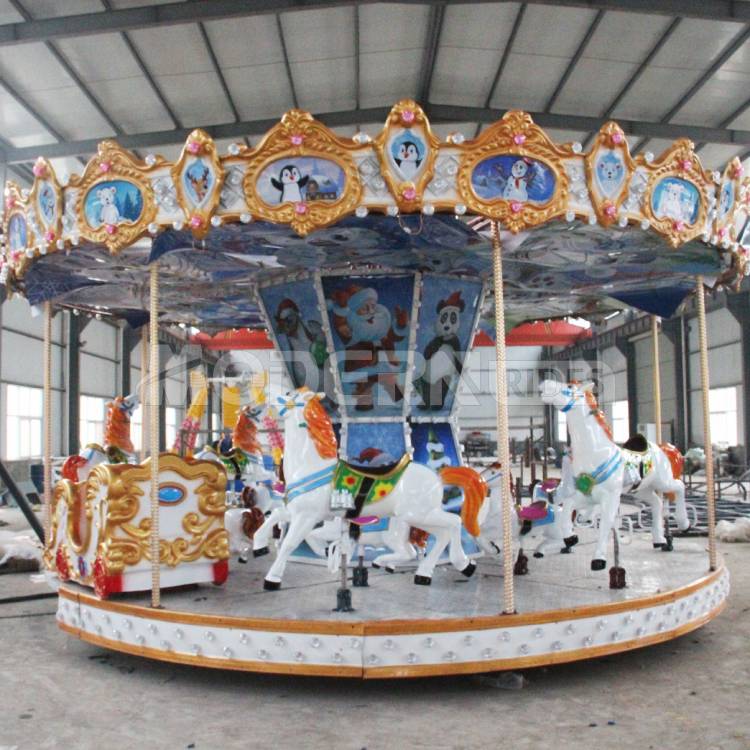
Although no permanent concrete foundation is required, site preparation remains critical.
Operators must verify:
-
Surface flatness within ±5 mm across full diameter
-
Compacted soil density ≥95% Proctor (for ground installation)
-
Drainage away from base frame
-
Indoor structural load capacity (for malls or rooftops)
Improper leveling can cause uneven bearing stress, leading to premature wear.
Professional Operation and Maintenance Guide (Detailed Practical Section)
The long-term safety of a Foundationless Carousel Ride depends heavily on structured maintenance discipline.
Daily Pre-Opening Checklist
Operators should inspect:
-
Base frame alignment and visible deformation
-
Tightness of structural bolts using torque wrench
-
Seat fixtures and safety bars
-
Platform surface integrity
-
Electrical control panel status lights
-
Emergency stop functionality
A full operational test cycle must be completed before admitting passengers.
Weekly Maintenance
Every week, maintenance personnel should:
-
Re-check torque values of high-stress structural bolts
-
Inspect drive chain or belt tension (if applicable)
-
Verify lubrication condition of gearbox
-
Inspect bearing noise during slow-speed rotation
-
Confirm VFD parameter stability
Minor misalignment detected early prevents long-term structural fatigue.
Monthly Mechanical Inspection
Monthly inspection should include:
-
Removal of access covers to inspect gearbox seals
-
Bearing temperature measurement after operation
-
Inspection for micro-cracks at welded joints
-
Re-leveling verification using laser level tool
-
Electrical cabinet dust cleaning
Corrosion spots must be treated immediately to prevent structural weakening.
Quarterly Operational Audit
Every three months:
-
Conduct full-load simulation test
-
Measure vibration levels
-
Re-calibrate speed controller
-
Inspect anti-corrosion coating condition
Outdoor installations require additional wind-exposure inspection.
Annual Structural Review
A professional technician or third-party inspector should:
-
Verify base frame flatness
-
Inspect weld integrity
-
Review electrical grounding resistance
-
Audit maintenance log documentation
Failure to maintain records can affect insurance validity in regulated markets.
Wind and Environmental Control
For outdoor installations, operation should be suspended when wind speed exceeds manufacturer limits (commonly 15–20 m/s depending on ride diameter).
Water accumulation under base frame must be prevented to avoid soil settlement.
Investment Considerations
A Foundationless Carousel Ride typically falls within:
-
Small size (6–8 m): USD 35,000–65,000
-
Medium size (8–10 m): USD 65,000–120,000
-
Larger configurations: USD 120,000–200,000
These figures reflect standard commercial-grade manufacturing without extreme customization.
Lower civil engineering cost partially offsets equipment investment.
Conclusion
A Foundationless Carousel Ride represents a structurally engineered alternative to traditional fixed carousels. It achieves installation flexibility without compromising safety when properly designed, manufactured, installed, and maintained.
True safety depends on:
-
Verified structural calculations
-
Controlled welding and material traceability
-
Electrical compliance
-
Documented maintenance discipline
For professional amusement operators, a Foundationless Carousel Ride offers mobility, lower site impact, and stable long-term performance when engineering standards are respected.
Online Message
Please leave the message you want to inquiry. We will reply you as soon as possible within 24 hours.