News detail
Portable Amusement Rides: Evolution & 2026 Trends | MODERN Rides
From Manual Rigging to One-Touch Hydraulics: The Evolution and Future of Portable Amusement Rides
Executive Summary for Buyers:
Primary Operational Goal: Minimize teardown and setup time to maximize ticket-selling hours.
Evolution Milestone: Shift from 12+ hour manual assembly (Gen 1.0) to 1-3 hour automatic hydraulic deployment (Gen 3.0).
2026 Key Trends: Single-operator hydraulic setup, pre-wired "lossless folding" RGB LED lighting, Variable Frequency Drive (VFD) fuel savings, and integrated VIN road compliance.
Core Business Impact: Reduces crew labor costs by up to 70% and enables multi-city weekend event hopping.
The Economics of Mobility in Traveling Carnivals
In the mobile carnival industry, investing in modern portable amusement rides directly impacts profitability. Every hour saved during site assembly is an extra hour available for ticket sales.
Historically, traveling carnival operators faced a tough trade-off: high-attraction rides required heavy, complex assembly, while easy-to-move rides lacked visual impact.
Today, advances in heavy-duty trailer engineering and automated hydraulics have changed this dynamic. Modern portable carnival rides are engineered not just as entertainment devices, but as compact, highway-compliant mobile assets designed to move quickly between event locations.
How Modern Portable Amusement Rides Have Evolved
The design of mobile amusement rides has evolved through three distinct technical generations over the past four decades:
Gen 1.0: Modular Manual Assembly (1970s–1990s)
Heavy loose components, crane dependencies, 6-8 crew members, 12-24 hr setup.
Gen 2.0: Semi-Trailer Mounted Rides (2000s–2010s)
Chassis integration, manual pinned arms, external lighting assembly, 4-6 hr setup.
Gen 3.0: One-Touch Hydraulic Systems (Present–2026)
Trailer IS the foundation, self-unfolding outriggers, integrated LEDs, 1-2 hr setup by 1-2 operators. Today, 3.0-generation portable amusement rides allow carnival operators to cut labor expenses while expanding their multi-city operating schedule.
Generation 1.0: Manual Modular Assembly (1970s–1990s)
Early traveling rides consisted of loose structural steel tubes, separate motors, and detachable passenger cars.
-
High Labor Costs: Required a crew of 6 to 8 skilled technicians.
-
Crane Dependencies: Heavy main shafts required external cranes for lifting.
-
Long Setup Windows: Assembling a classic Ferris wheel or swing ride took 12 to 24 hours of continuous manual labor.
Generation 2.0: Semi-Trailer Integrated Rides (2000s–2010s)
Engineers began mounting main machinery onto heavy-duty trailer chassis.
-
Partial Integration: The core motor and center post remained on the trailer, but support arms, platforms, and decorative panels were stowed separately.
-
Manual Pinning: Operators still had to manually position and pin heavy structural steel arms.
-
Separate Electrical Wiring: Lighting decorative pieces had to be mounted and plugged in manually after mechanical assembly.
Generation 3.0: Fully Automated Hydraulic Rides (Present–2026)
Modern trailer-mounted amusement rides use the trailer chassis itself as the operational foundation.
-
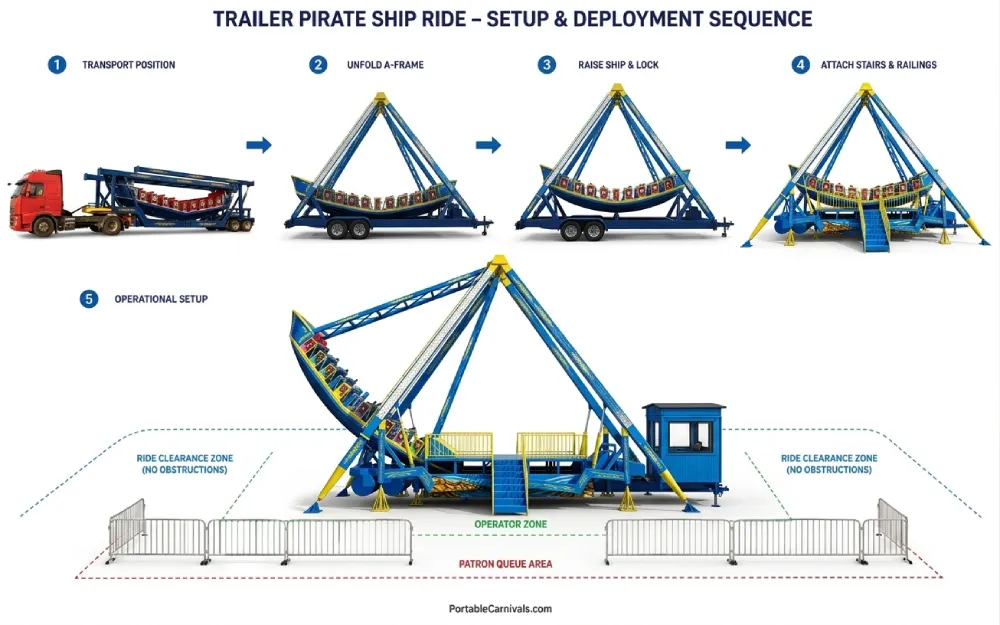
Zero-Crane Deployment: Powerful hydraulic rams lift center columns and fold out support arms automatically.
-
Integrated Hydraulic Outriggers: Outriggers extend from the trailer chassis, eliminating the need for poured concrete foundations.
-
Pre-Wired Infrastructure: Lighting cables, hydraulic hoses, and power lines are routed through internal channels during manufacturing.
Comparison: 1.0 Manual Assembly vs. 3.0 Hydraulic Automation
| Operational Parameter | Gen 1.0 Manual Assembly | Gen 3.0 Hydraulic Automation |
| Average Setup Time | 12 – 24 Hours | 1 – 3 Hours |
| Required Crew Size | 6 – 8 Skilled Laborers | 1 – 2 Trained Operators |
| Lifting Equipment Needed | Crane / Heavy Forklift Required | None (Self-Erecting Hydraulic Rams) |
| Transport Vehicles | 2 – 3 Heavy Trucks | 1 Standard Tractor Trailer |
| Workplace Injury Risk | High (Heavy manual lifting at height) | Low (Ground-level control station) |
| Electrical Setup | Manual cabling and light mounting | Pre-wired plug-and-play connections |
2026 Engineering Trends in Portable Amusement Rides
As event operators face rising labor costs, stricter road transportation rules, and higher diesel prices, equipment manufacturers have introduced several key engineering improvements for 2026:
1. Zero-Crane Hydraulic Setup (Solving Labor Shortages)
Finding skilled temporary labor is one of the biggest challenges for carnival operators today. 2026-grade portable rides use multi-stage hydraulic telescoping columns and hydraulic locking pins. A single operator standing at a ground-level hydraulic control station can deploy a full-sized ride—such as a portable pendulum or flying chair—in under two hours.
2. Pre-Wired "Lossless Folding" RGB LED Systems
In older designs, decorative LED lights had to be unmounted before folding the ride to prevent bulb damage during transport. Modern rides feature recessed LED channels and flexible wiring joints. Lights fold inside protective steel channels during transit, allowing operators to power on the light show immediately after mechanical setup.
3. Variable Frequency Drives (VFDs) for Generator Fuel Efficiency
Most mobile carnivals run on diesel generators. Older direct-on-line motors create high electrical power surges during startup, requiring larger generators. Modern equipment incorporates Variable Frequency Drives (VFDs), which smooth out electrical draw, reduce mechanical wear, and lower generator fuel consumption by up to 25%–30%.
4. Global Highway Compliance and VIN Standardisation
Cross-border fair operators and equipment rental companies require machinery that can travel on public roads without special transport permits. Leading amusement equipment manufacturers now supply trailer chassis built to international highway standards:
-
17-Digit Vehicle Identification Numbers (VINs) for easy Department of Transportation (DOT) and European vehicle registration.
-
Dual-Line Air Brake Systems & ABS for highway stability.
-
Standardized Widths (<2.55m) to eliminate over-width transit permits in North America and Europe.
How Portable Amusement Rides Maximize Profitability
Upgrading to 3.0-generation portable carnival rides directly improves a carnival business's bottom line:
-
More Revenue Days Per Season: Reducing setup time from two days to three hours allows operators to run weekend events in two different cities back-to-back, adding 15–20 additional operating days per season.
-
Lower Payroll Expenses: Operating a 5-ride carnival layout with a 4-person crew instead of a 20-person crew saves thousands of dollars in weekly labor, housing, and transport costs.
-
Faster Site Clearance: Quick teardown helps operators vacate rented land promptly, avoiding late penalties from event venues and local councils.
Selection Guidance for Buying Portable Amusement Rides
The evolution of portable carnival rides is defined by a shift from manual labor to automated operational efficiency. The most valuable mobile ride is not simply the one with the brightest lights or highest peak capacity; it is the ride that can be moved, deployed, operated, and stored with the lowest friction and cost.
When evaluating mobile amusement rides for sale, operators should look beyond initial purchase price and assess:
-
Hydraulic folding mechanism durability.
-
Vehicle chassis highway compliance (VIN and braking specs).
-
Setup crew requirements and generator power draw.
MODERN delivers turn-key portable amusement ride solutions engineered for high mobility, strict safety compliance, and maximum return on investment. Contact our engineering team today to review customized trailer ride solutions for your upcoming operating season.
Online Message
Please leave the message you want to inquiry. We will reply you as soon as possible within 24 hours.