News detail
Core Factors Influencing Ferris Wheel Pricing: A Comprehensive Analysis Guide
I. Introduction
Ferris wheels, as iconic attractions in amusement parks, theme parks, and even urban landscapes, hold countless memories and moments of joy for people worldwide. From miniature versions in family-friendly parks to colossal city-defining structures like the London Eye, their price ranges vary dramatically—spanning from hundreds of thousands to tens of millions of yuan. For theme park investors, carnival organizers, and cultural tourism developers, accurately grasping the pricing logic of Ferris wheels is crucial for making informed investment decisions and optimizing cost structures.
Why do seemingly similar “giant rotating wheels” carry such vastly different price tags? The answer lies not in a simple “size determines price” formula, but in the interplay of multiple core factors. This article will dissect the five core elements influencing Ferris wheel pricing, along with two often-overlooked practical cost considerations, helping readers fully understand the pricing mechanism and avoid investment pitfalls.
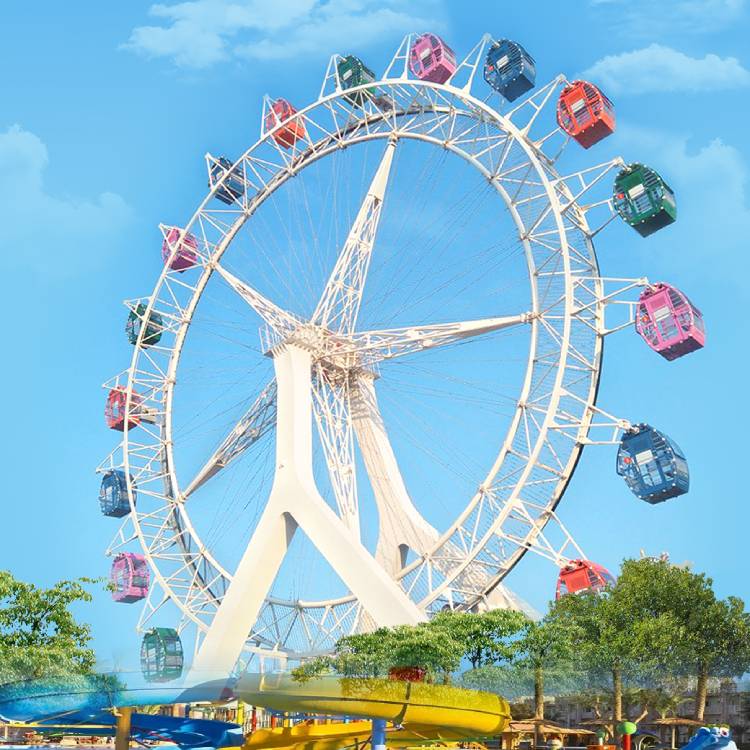
II. Manufacturer's Reputatio
In Ferris wheel procurement decisions, the manufacturer's reputation and brand strength are the primary variables affecting price. A Ferris wheel's safety performance, durability, and after-sales service quality are directly tied to the manufacturer's technical expertise and production standards—factors that ultimately reflect in the price tag.
(1) The Premium Logic of Renowned Brands
Internationally recognized Ferris wheel manufacturers like Beston Rides and Extreme Engineering often command higher prices for their products, backed by sound rationale:
Quality Assurance: Premium brands utilize high-specification materials, such as corrosion-resistant, high-strength steel for wind resistance and wear-resistant, heat-tolerant cabin materials. This ensures the equipment withstands harsh outdoor conditions and high-frequency operation over extended periods.
Comprehensive Service: They offer extensive warranty coverage (typically 1-5 years) and professional lifetime maintenance plans, including regular inspections, component replacements, and technical support, significantly reducing operational risks over time.
Safety Certification: Products are certified to international amusement ride safety standards (e.g., ISO, ASTM), meeting operational requirements in most global regions without requiring additional compliance modifications.
(2) Risks of Low-Cost Niche Brands
Opting for lesser-known or niche Ferris wheel brands may reduce upfront procurement costs but often carries hidden dangers:
Quality Compromises: To control costs, some niche brands may use substandard materials, shortening equipment lifespan and increasing failure rates;
Service Gaps: Lacking robust after-sales support systems, timely repairs become difficult after equipment failures, potentially causing prolonged downtime losses;
Safety Hazards: Without authoritative safety certifications, risks of design flaws or manufacturing defects exist, potentially triggering accidents and regulatory penalties.
Therefore, procurement should not solely pursue low prices. Instead, comprehensively evaluate manufacturers' industry experience, customer feedback, and safety records to avoid paying greater long-term costs for short-term savings.
III. Size and Capacity
The dimensions (height, diameter) and passenger capacity of a Ferris wheel are the most direct determinants of manufacturing costs, exhibiting a clear positive correlation with price.
(1) Direct Link Between Dimensions and Cost
Ferris wheel manufacturing is fundamentally a large-scale steel structure project. Greater dimensions demand higher material strength, more complex structural design, and greater engineering precision:
Raw Material Consumption: Giant Ferris wheels consume hundreds of tons of steel, with material costs alone far exceeding those of smaller units.
Design Complexity: Larger structures must withstand stronger wind loads, seismic forces, and other natural stresses, requiring more intricate structural design and higher R&D/calculation expenses.
Production Processes: Manufacturing large components demands stricter standards for machining, welding, and coating, extending production cycles and increasing labor and equipment depreciation costs.
(2) Price Tiering by Size and Capacity
Mini Ferris Wheels: Typically 8-15 meters tall with a capacity of 6-12 passengers, primarily used in children's playgrounds, shopping mall atriums, and small carnivals. Prices generally range from 300,000 to 800,000 yuan.
Medium Ferris Wheels: Height 20-40 meters, capacity 24-48 passengers. Mainstream choice for urban parks and conventional carnivals, priced between ¥1,000,000 - ¥3,000,000;
Large Ferris Wheels: Height 50-100 meters, capacity 50-100 passengers. Suitable for large theme parks and cultural tourism resorts, priced between 5 million and 15 million yuan.
Giant Ferris Wheels (Landmark-Class): Height exceeding 100 meters, capacity over 100 passengers (e.g., London Eye at 135 meters with 800 passengers). Requires customized design and construction, with prices reaching tens of millions or even hundreds of millions of yuan.
(3) Hidden Costs Associated with Size
Beyond the equipment cost itself, larger Ferris wheels incur additional hidden expenses: such as requiring more robust foundation engineering, more complex electrical systems, and higher transportation and installation fees. These must be factored into the overall investment budget.
IV. Type of Ferris Wheel
Differences in Ferris wheel classification and structural design directly impact manufacturing complexity and cost, resulting in significant price variations between equipment types.
(1) Types Classified by Usage Scenarios and Capacity
Single-sided Mini Ferris Wheel: Features a simple structure with cabins on one side only, targeting the children's market. Its low manufacturing complexity makes it one of the most affordable types.
Carnival Ferris Wheel: Medium-sized with a classic single-sided design, balancing entertainment and practicality. Offering high cost-effectiveness, it remains the mainstream choice for the mass market.
Double-sided Ferris wheel: Features cabins on both sides, doubling passenger capacity within the same footprint. Its structural design is more complex (requiring balanced weight and stress distribution on both sides), commanding a 30%-50% premium over similarly sized single-sided models;
Giant Landmark Ferris Wheels: Designed specifically for urban landscapes and large-scale cultural tourism projects, often employing support-free or long-span structures. These present extremely high technical challenges and occupy the pinnacle of the pricing pyramid.
(2) Traditional Spoked vs. Modern Spoke-Free
Traditional Spoked Ferris Wheels: Centered around a core shaft connected to the rim by spokes. Featuring mature technology and lower manufacturing costs, this is the most common type on the market;
Spoke-less Ferris Wheels (Ring Ferris Wheels): Featuring a giant ring appearance without central spokes, these rely on the structural strength of the rim itself and the drive system. Their futuristic design demands exceptional material strength, welding techniques, and drive technology, resulting in manufacturing costs exceeding those of spoke-type ferris wheels of the same size by over 50%.
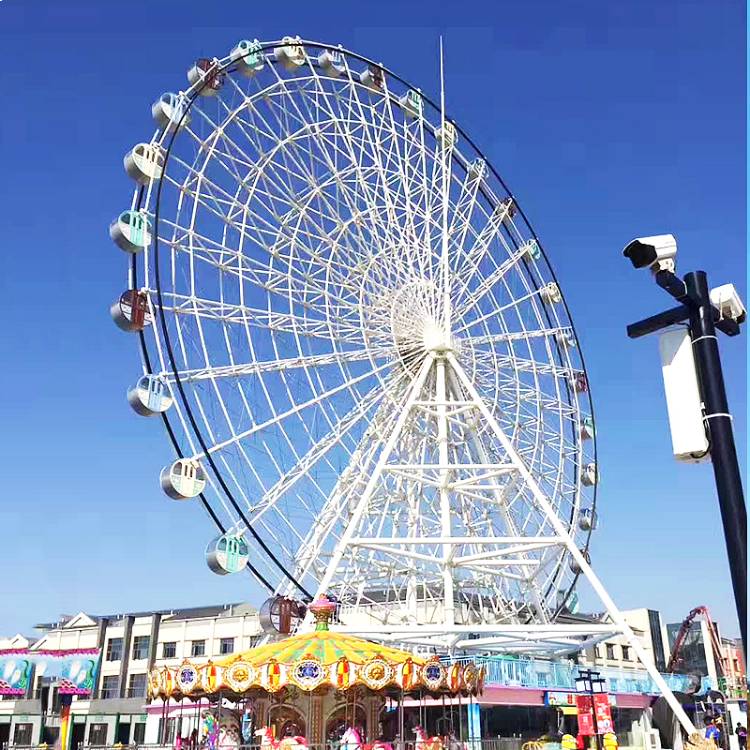
V. Design and Customization
Standard Ferris wheels represent the “value-for-money choice,” while customized designs justify a “premium price.” Whether to incorporate thematic customization and the scope of such customization directly impact the final cost.
(1) Price Difference Between Standard and Custom Models
Standard Ferris wheels employ universal designs (fixed colors, conventional cabin shapes, basic lighting), enabling manufacturers to produce in bulk at lower costs. Custom models require redesigning, mold creation, and debugging based on client specifications, significantly increasing labor and time costs. Prices typically exceed standard models by 20%-100%, depending on customization complexity.
(2) Common Customization Directions and Cost Impacts
Theme Appearance Customization: Adjusting color schemes (e.g., Disney-inspired fantasy palettes) and rim patterns (e.g., city logos, holiday motifs) to match park themes incurs additional design fees and painting costs.
Cabin Customization: Modifying standard cabins into special shapes (e.g., cartoon characters, capsules, luxury compartments) or adding features (e.g., air conditioning, sound systems, panoramic windows, leather seats). Customization costs per cabin can reach tens of thousands of yuan.
Lighting System Customization: Basic models feature standard illumination. Custom options include full-color LED strips and dynamic light show systems (supporting music synchronization and pattern transitions). Premium lighting systems may account for 10%-20% of total equipment costs;
(3) The “Value Return” of Customization
While customization increases costs, well-executed customization can transform a Ferris wheel into an “exclusive IP,” enhancing the park's distinctiveness and appeal. This boosts ticket sales and secondary spending, shortening the investment payback period. For theme parks prioritizing differentiated competition, the premium for customization is often a “worthwhile investment.”
VI. Shipping & Installation Charges
Ferris wheel pricing is not isolated but influenced by external factors including market supply-demand dynamics, regional supplier distribution, and industry competition.
(1) Impact of Supply-Demand Dynamics
During periods of high market demand (e.g., cultural tourism project booms, major exhibition preparations), suppliers face order saturation, reducing bargaining power and potentially raising prices by 10%-20%. Conversely, during market off-seasons or periods of intense industry competition, suppliers may introduce promotional policies, making prices more flexible.
(2) Supplier Competitive Landscape
Large Ferris wheel manufacturers (e.g., Beston, enterprises under China Shipbuilding Industry Corporation) dominate the mid-to-high-end market with technological and production capacity advantages, maintaining relatively stable pricing. Smaller manufacturers concentrate in the low-to-mid-end market, competing on price to capture market share, though their product quality and service may have shortcomings.
VII. Practical Considerations: Transportation and Installation Costs
Many buyers overlook transportation and installation expenses, yet these costs can constitute 10%-30% of the total equipment price—unavoidable “hidden expenditures.”
(1) Core Factors Affecting Transportation Costs
Transportation Distance: Local suppliers incur lower costs (primarily road transport), while international procurement requires ocean/air freight. Intercontinental shipping may reach hundreds of thousands of yuan (especially for large components of giant Ferris wheels requiring specialized transport vehicles or containers).
Equipment Dimensions and Weight: Mini Ferris wheels can be transported as a single unit at lower cost; large Ferris wheels require disassembly into components like rims, cabins, and supports, significantly increasing transportation complexity and expenses.
Transportation Route: Remote areas, mountainous regions, or sites with poor access incur additional secondary transportation fees.
(2) Key Variables in Installation Costs
Installation complexity: Miniature Ferris wheels assemble rapidly, with installation fees in the tens of thousands of yuan. Large Ferris wheels require cranes (or even super-large crawler cranes) and specialized installation teams (structural engineers, skilled technicians), with installation cycles lasting weeks and costs reaching hundreds of thousands of yuan.
Site Conditions: Additional costs arise for site preparation and installation adjustments if the installation area requires pre-leveling, foundation reinforcement, or addresses height restrictions and surrounding obstacles.
International Procurement Surcharges: When sourcing from overseas, import duties, value-added tax, customs clearance fees, and other charges beyond transportation costs must be factored into the overall budget.
(3) Cost-Effectiveness Trade-offs Between Local vs. International Procurement
Local procurement offers advantages in convenient transportation/installation and rapid after-sales response, but carries higher prices. Internationally procured equipment (e.g., from China or Europe) has lower base prices; even after adding transportation and tariffs, total costs may still be 20%-30% lower than local procurement. However, suppliers' installation guidance services and after-sales support capabilities must be verified beforehand.
VIII. FAQs (SEO-Optimized)
1. What is the typical price range for a Ferris wheel?
Answer: Prices vary significantly:
- Mini (8-15 meters): ¥300,000 - ¥800,000
- Medium (20-40 meters): ¥1,000,000 - ¥3,000,000 large (50-100 meters): ¥5-15 million; mega landmark-class (over 100 meters): tens of millions to over ¥100 million. Core factors include size, brand, and customization level.
2. Is the premium for a well-known Ferris wheel brand worth paying?
Answer: Yes. Equipment from renowned brands offers greater assurance in safety performance, durability, and after-sales support, reducing losses from future maintenance downtime. Taking a medium-sized Ferris wheel as an example, while a well-known brand may cost 30% more than a lesser-known one, its lifespan could be 5-10 years longer, and all repairs during the warranty period are covered at no cost, making it more cost-effective in the long run.
3. Does customization always incur extra costs? Are there cost-effective customization options?
Answer: Yes, customization inevitably adds costs. For limited budgets, prioritize “light customization”: such as tailoring the lighting system (enhancing nighttime appeal) or making simple color scheme adjustments. This achieves differentiation without significantly exceeding the budget.
4. Which is more cost-effective: imported or domestically produced Ferris wheels?
Answer: In most cases, domestically produced Ferris wheels offer better value. Domestic equipment meets international technical standards while costing 30%-50% less than imports, with more convenient transportation, installation, and after-sales service. For those seeking premium craftsmanship or specific brands, European or American imports are available but require a higher budget.
5. Beyond equipment cost and transportation/installation fees, what hidden costs should be budgeted?
Answer: Key hidden costs include: foundation reinforcement (mandatory for large Ferris wheels), annual maintenance fees (2%-5% of total equipment cost), replacement parts (e.g., cabin seats, lighting components), insurance premiums, and operator training fees. It is advisable to allocate 10%-15% of the total budget for these hidden expenses.
IX. Conclusion
Ferris wheel pricing is not determined by a single factor but rather by the interplay of five core elements: manufacturer reputation, size/capacity, type/structure, customization level, and market dynamics—alongside practical considerations like transportation and installation. For investors, blindly pursuing “low prices” may expose them to safety and quality risks, while relentlessly chasing “high-end customization” can lead to cost wastage.
The optimal decision path is: First clarify your requirements (site size, target audience, budget range, operational scenarios), then prioritize each factor accordingly: Large-scale cultural tourism projects may favor “custom giant Ferris wheels + renowned brands” to create iconic landmarks. Finally, comprehensively calculate equipment costs, transportation/installation fees, and post-installation maintenance expenses to achieve “cost-value balance.”
May this analysis help you navigate Ferris wheel procurement more efficiently, ensuring this joy-filled attraction becomes both an appealing and cost-effective investment.
Online Message
Please leave the message you want to inquiry. We will reply you as soon as possible within 24 hours.