News detail
Comprehensive Technical Guide for Carousel Amusement Rides
Industry Advisory: Many procurement officers treat Carousel Rides as purely aesthetic assets, yet they are high-torque, rotating mechanical systems subject to constant fatigue. This document analyzes the critical engineering thresholds that separate landmark attractions from high-maintenance liabilities.
1. Carousel Rides Overhead Crank System vs. Bottom-Drive Transmission
The propulsion architecture is the primary determinant of an attraction's maintenance lifecycle. In Carousel Rides, an overhead crank system offers a classic aesthetic but introduces high-level maintenance risks due to gravity-fed lubrication requirements. Conversely, a bottom-drive transmission lowers the center of mass and places the motor and gearbox in accessible locations for thermal imaging and vibration analysis, significantly reducing downtime.
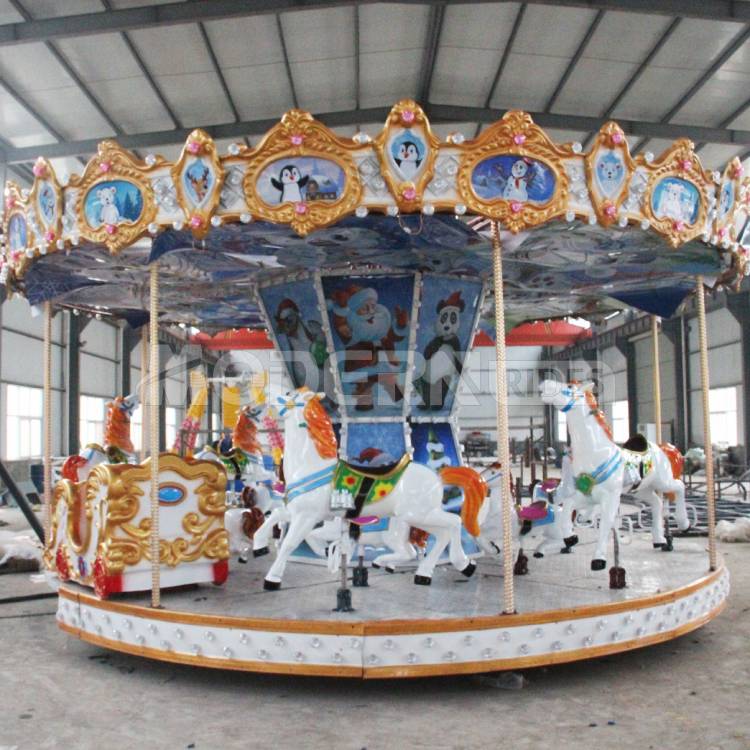
2. Centrifugal Force Management in High-Capacity Carousel Rides
As platform size increases, the outer row of figures experiences significantly higher tangential speeds. Centrifugal force management in high-capacity Carousel Rides is not merely a passenger comfort issue; it involves the management of lateral shear stress on jumping poles. Engineering for these forces requires reinforced radial sweeps to ensure the platform remains stable under the asymmetrical weight of 50+ riders.
3. Precision Timing of Vertical Oscillation in Carousel Rides Jump Mechanisms
Fluid "galloping" motion is the result of eccentric gear synchronization. The vertical oscillation in Carousel Rides jump mechanisms must be timed to avoid "mechanical slap"—the jarring impact at the top and bottom of the stroke. Proper dampening in the connecting rods is what separates a premium ride from one that experiences resonant frequency clatter after short-term operation.
4. Mechanical Load Distribution for Multi-Tier Carousel Rides
A double-decker configuration represents a vertical loading challenge. Mechanical load distribution for multi-tier Carousel Rides requires a central mast capable of supporting massive axial compression. If the cantilevered supports for the second level lack precision welding, platform deflection will occur, leading to premature bearing failure and uneven track wear.
5. Torque Requirements for Variable Frequency Drive (VFD) in Carousel Rides
Starting a 10-ton rotating mass from a standstill requires a massive energy surge. Integrating Variable Frequency Drives (VFD) in Carousel Rides manages these torque requirements. By programming an "S-curve" acceleration, the VFD eliminates the "jerk" that shears gearbox teeth and blows fuses, while also cutting idle power consumption.
6. Comparative Durability of FRP (Fiberglass) vs. Wood for Carousel Rides Figures
The debate between tradition and operational reality is settled in the maintenance budget. A comparative durability analysis of FRP (Fiberglass) vs. wood for Carousel Rides figures reveals that automotive-grade FRP provides superior weight-to-strength ratios. Unlike wood, FRP is immune to environmental rot and splitting in humid climates, offering lower long-term restoration costs for high-traffic venues.
7. Automotive-Grade UV-Resistant Coatings for Outdoor Carousel Rides
Sunlight is a primary catalyst for material degradation. Without automotive-grade UV-resistant coatings for outdoor Carousel Rides, fiberglass surfaces suffer from photo-oxidation. These multi-layer clear coats act as a sacrificial barrier, preserving the structural surface integrity and aesthetic luster against intense UV radiation.
8. Structural Integrity of the Center Pole in Permanent Carousel Rides Installations
The center pole is the spine of the attraction. Ensuring the structural integrity of the center pole in permanent Carousel Rides installations requires seamless, thick-walled carbon steel. Any bowing in this pole under load will cause the entire top-heavy structure to oscillate, creating a safety hazard and compounding mechanical wear on the drive wheels.
9. Corrosion Resistance Standards for Carousel Rides in High-Salinity Coastal Areas
Coastal environments demand specialized metallurgy. Adhering to corrosion resistance standards for Carousel Rides in high-salinity coastal areas involves hot-dip galvanization and marine-grade epoxy primers. Following ISO 12944 protection standards ensures that the structural steel remains immune to the corrosive effects of salt air.
10. Fire Retardant Requirements for Indoor Carousel Rides Materials
For mall or indoor park installations, fire safety is a regulatory hurdle. Meeting fire retardant requirements for indoor Carousel Rides materials means all resins and electrical conduits must be certified UL 94-V0. This engineering detail is essential for passing final building inspections and ensuring passenger safety in enclosed spaces.
11. ASTM F24 Compliance for Carousel Rides Restraint Systems
Modern liability management mandates strict adherence to global codes. ASTM F24 compliance for Carousel Rides restraint systems ensures that even slow-moving rides prevent accidental falls. This involves specific "pull-tests" on safety belts and ergonomic handhold placements that account for the physiological realities of small children.
12. EN 13814 Certification for Structural Steel used in Carousel Rides
For international markets, EN 13814 certification for structural steel used in Carousel Rides is the benchmark for quality. It requires full material traceability, verifying the smelting parameters of the steel and the credentials of the welder, providing indisputable proof of build quality for institutional investors.
13. Emergency Braking Distance and Deceleration Rates for Carousel Rides
In the event of an emergency stop (E-Stop), deceleration must be controlled. Emergency braking distance and deceleration rates for Carousel Rides are calibrated so the ride stops within seconds without causing secondary injuries. This involves a combination of dynamic motor braking and physical backup friction brakes.
14. Redundant Safety Fasteners for Suspended Figures in Carousel Rides
Secondary safety systems are critical in professional ride design. The use of redundant safety fasteners for suspended figures in Carousel Rides—such as aircraft-grade cables—ensures that if a primary mounting bolt shears due to metal fatigue, the figure remains tethered to the pole.
15. Safety Clearance Envelopes for Dual-Row Carousel Rides Configurations
"Pinch points" are the most common risk factor for rider injury. Mapping the safety clearance envelopes for dual-row Carousel Rides configurations ensures that passengers cannot interfere with adjacent mechanisms or riders, maintaining a strict "no-contact" zone throughout the ride cycle.
16. Total Cost of Ownership (TCO) for Antique-Style vs. Modern Carousel Rides
Procurement decisions should be based on the Total Cost of Ownership (TCO) for antique-style vs. modern Carousel Rides. Modern units with sealed-for-life bearings and modular electronics require significantly less manual labor, allowing the maintenance team to focus on higher-complexity assets.
17. Predictive Maintenance for Carousel Rides Slewing Bearings and Rollers
Downtime is lost revenue. Predictive maintenance for Carousel Rides slewing bearings and rollers involves using ultrasonic sensors to detect "metal-on-metal" friction before it is visible. Replacing a roller during off-peak hours is far more cost-effective than an emergency slewing ring replacement after a seizure.
18. ROI Modeling for Carousel Rides based on Hourly Passenger Throughput (TPH)
Profitability is a function of cycle time and capacity. ROI modeling for Carousel Rides based on hourly passenger throughput (TPH) analyzes gate design and seat layout efficiency. Optimizing "Actual TPH" ensures the equipment reaches its breakeven point in record time.
19. Depreciation Schedules for Commercial-Grade Carousel Rides Assets
A carousel is a durable capital asset with a 20+ year lifespan if maintained properly. Managing the depreciation schedules for commercial-grade Carousel Rides assets is key for park financial health. High-quality builds with NDT (Non-Destructive Testing) records maintain a much higher resale value on the secondary market.
20. Energy Consumption Optimization for LED-Integrated Carousel Rides
Modern lighting should not be an energy drain. Energy consumption optimization for LED-integrated Carousel Rides uses 24V LED systems that draw 80% less power than traditional incandescent bulbs. This lowers utility costs and significantly reduces the labor hours spent on bulb replacement.
Online Message
Please leave the message you want to inquiry. We will reply you as soon as possible within 24 hours.