News detail
Amusement Park Master Planning: Ride Zoning & Flow | MODERN
Master Planning 101: Ride Zoning, Capacity Design & Foot Passenger Flow
Executive Summary for Park Developers & Planners:
Primary Strategic Goal: Create an immersive, high-throughput park layout that maximizes guest satisfaction, eliminates midway bottlenecks, and optimizes secondary spend.
Core Architectural Principle: Balancing thrill anchors, family zones, and kiddie rides across structured circulation paths (Hub-and-Spoke vs. Continuous Loop).
Capacity & Throughput: Matching global Passengers Per Hour (PPH) targets with queue line geometry and station turnaround efficiency.
Safety & Logistics: Integrating emergency vehicle access, service corridors, and compliance standards such as ASTM F2291 standards into initial land-use blueprints.
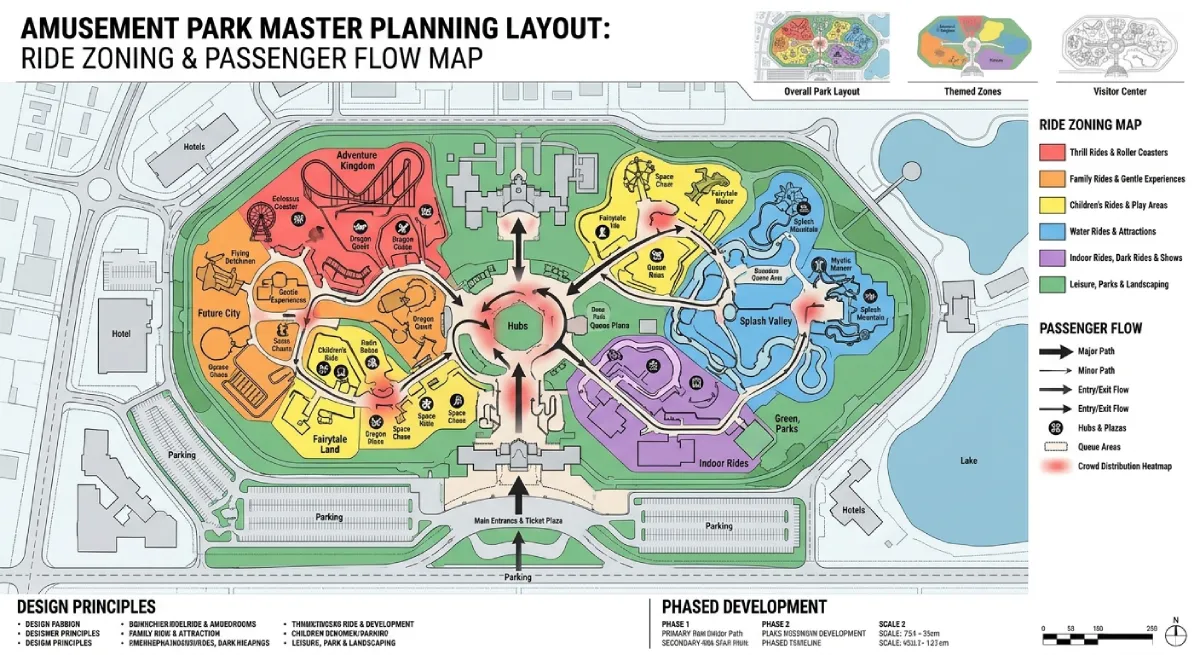
Executing successful amusement park master planning is the critical foundation of any commercial entertainment project. A visually stunning park with poor spatial flow will inevitably suffer from crowded walkways, excessive queue frustration, and underperforming concession outlets. Therefore, effective planning translates raw acreage into a balanced, high-yield entertainment engine.
The Science of Amusement Park Master Planning and Layout
Effective amusement park master planning strategically places high-capacity anchors to disperse crowd density throughout the property. As a result, guests remain engaged longer, directly increasing per capita spending on food, beverage, and retail merchandise.
1. Ride Zoning in Amusement Park Master Planning
A successful amusement park layout divides attractions into distinct zones tailored to specific visitor demographics while maintaining visual harmony across the property.
The Anchor & Magnet Strategy
-
Thrill Anchors (Extreme Zone): Roller coasters, drop towers, and high-speed pendulum rides act as visual magnets. Placing these major attractions toward the perimeter or back of the park draws foot traffic deep into the property.
-
Family & Kiddie Hubs (Central Zone): Gentle family rides, bumper car arenas, and spinning teacups are best clustered near central plazas where parents can comfortably supervise young children.
-
Interspersed Secondary Attractions: High-throughput family rides—such as a classic trailer-mounted carousel for sale or portable swing chair—fill transit gaps between major zones, smoothing out crowd density.
2. Capacity Design in Amusement Park Master Planning
To prevent catastrophic midway congestion during peak days, a park's overall ride fleet must match projected daily attendance through precise Passengers Per Hour (PPH) calculations.
Balancing Hourly Ride Absorption
Every attraction possesses a theoretical operational capacity. Therefore, master planners utilize a standardized absorption formula:
Hourly Absorption = (Seats Per Vehicle × Vehicles Per Cycle × 60) / Total Dispatch Cycle Time (Minutes)
Queue Line Geometry and Overflow Buffer
-
Pairing Crowd Densities: Queue lines must be engineered to absorb 100% of peak line lengths without spilling out into main walkways.
-
Shaded Serpentine Queues: Utilizing multi-switchback serpentine queue lines with integrated shade canopies and misting fans reduces perceived wait times and prevents heat exhaustion.
3. Foot Passenger Flow in Amusement Park Master Planning
The physical path guests take through a park dictates both their physical comfort and their spending habits.
Structural Circulation Models: Hub-and-Spoke vs. Loop
-
Hub-and-Spoke (Central Plaza Model): Visitors enter a central hub and radiate outward toward themed lands. This structure makes orientation effortless and provides a natural location for flagship retail stores.
-
Continuous Loop (Circuit Model): Forces guest flow in a natural circular pattern around a central lake or feature. This guarantees that every retail shop and dining point receives equal foot traffic exposure.
Strategic Retail Integration
-
Exit Through Retail (ETR): High-thrill attractions should route exiting passengers directly through themed retail gift shops while photo-capture screens display action photos.
-
Concession Placement at Node Intersections: Food courts and beverage kiosks positioned at major path junctions capture impulse purchases from guests transitioning between major ride zones.
Master Planning Parameter Checklist for Project Engineers
Before finalizing land-use blueprints, engineering teams must audit these core parameters for amusement park master planning:
-
Emergency Service Access: Maintain minimum 4.5-meter-wide uninhibited access lanes connecting main entrances to perimeter service roads for emergency vehicles.
-
Back-of-House (BOH) Service Corridors: Ensure underground utility lines, ride maintenance bays, and employee break facilities remain completely hidden from guest sightlines.
-
Utility Hookup Calculations: Factor peak power draw and water filtration requirements for major mechanical rides into civil engineering schematics.
Partnering with MODERN for Master Planning & Ride Sourcing
Designing an efficient park layout requires seamlessly integrating civil architecture with mechanical ride engineering. MODERN works closely with park developers, investors, and master planners to supply high-capacity, international-standard attractions optimized for your site layout.
Developing a new park layout or optimizing foot flow for an existing venue? Contact our master planning consultants to review 3D site layout services, PPH capacity audits, and ride package options.
An Elicitation Question is a structured follow-up intended to proactively offer relevant next steps or adjacent tasks based on context.
-
Context-Driven: Make questions specific to the current workflow context.
-
Avoid Spam: Ask ONLY ONE relevant question per turn.
-
Be direct and action-oriented.


Online Message
Please leave the message you want to inquiry. We will reply you as soon as possible within 24 hours.